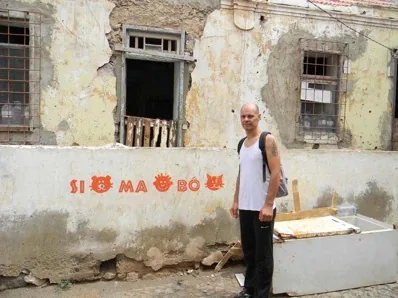
After 4 years, that is, since it was founded, I finally managed to visit the Simabo association (in Creole, “like you”), founded by Paolo and Silvia, whom I already knew from taking part together in AgireOra activities in Alessandria.
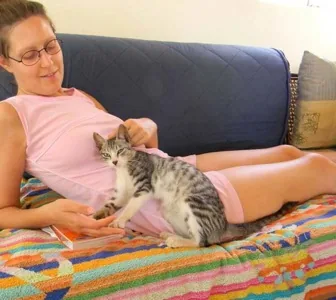
My big dream had always been to become a vet, either in a clinical setting or in research (I’ve lost quite a few cats to various illnesses that are still incurable), but in the end I ended up working in psychiatry… I’m easily suggestible, especially when it comes to animals…
That’s why I chose to visit the project during a holiday first, rather than dive straight into volunteering in an unfamiliar setting, without really knowing what to expect.
I travelled with my boyfriend and we relied on CV Info Service, the small tourist information agency through which Silvia and Paolo fund the project. Silvia answered a series of my questions that came from the fact that it was my first long trip and helped us plan it as best as possible, exactly as we wanted.
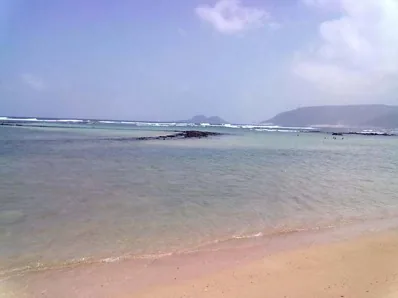
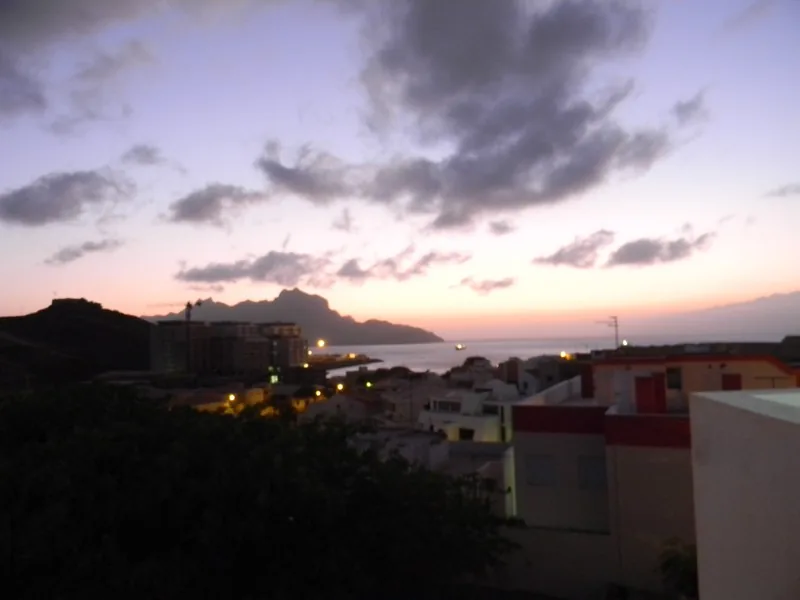
So in 3 weeks we visited Sao Vicente (staying in Mindelo, where the association is based), Santo Antao (guesthouse in Ponta do Sol) and Sal (a studio flat in touristy Santa Maria).
Our stay in Mindelo was immediately very striking: warned about the rising crime, we left money and documents at home, and I rarely felt free to use my camera. But above all, the visual impact of the stray animals was strong… dogs roaming everywhere and cats adopting you straight away…
On the first evening, as soon as we left the house, a little cat came up to us and melted into a heap of cuddles. After 2 hours it was still there, in the same spot waiting. How could we not take it home? In the square we met Silvia to give her the carrier we had brought from Italy (in Cape Verde there is very little for dogs and cats, and in the villages you can’t even find kibble). But first we… filled it – with a 2-month-old kitten who was screaming like mad, ignored by everyone in the middle of the square, kept in check only by the poor stray dogs. How could we leave him there? Within an hour we had adopted 2 kittens…
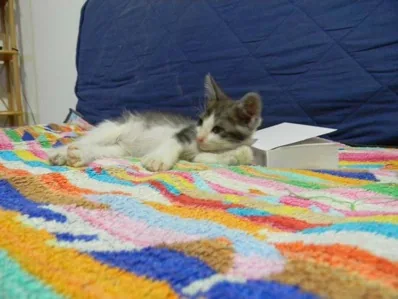
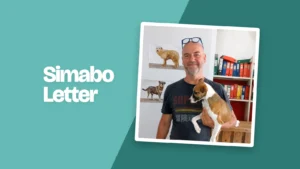
Little Feo (which in Spanish means ugly, the name Cristian gave him, though I don’t agree because he’s gorgeous as you can see from the photos) cried for most of the night we spent sleepless. In the morning on the terrace we found only the little one. We were still looking for the other one when, in the inner courtyard, we found a cat’s head. Silvia had told us that stray dogs can happen to rip cats apart, but that poor head seemed to have been placed there as a warning, because no dog could have got into the courtyard…
Luckily Capo Verde, the adult cat, came back a few hours after the head was found.. Or rather, we’re convinced it was him… In any case, since he reappeared, with a small infection on his paw, he no longer wanted to go out but always stayed close to us looking for attention.
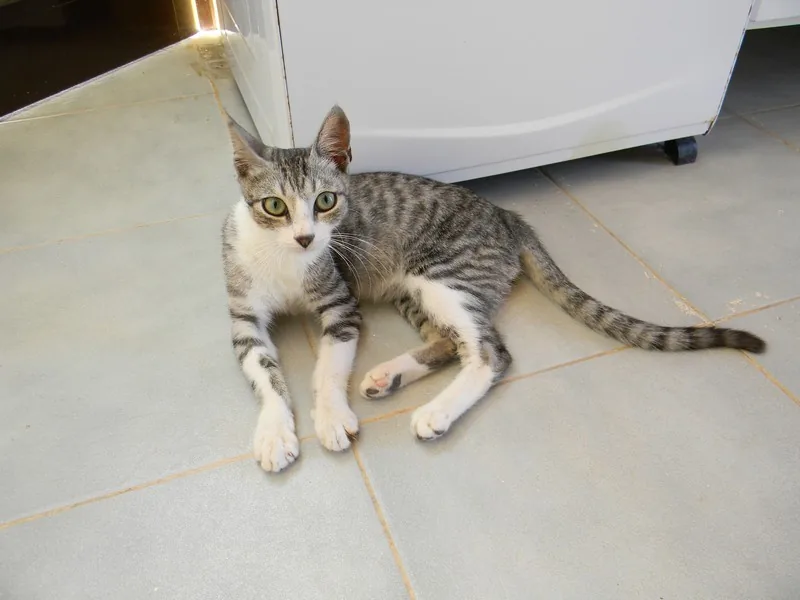
After these events, so as not to have any further problems, we entrusted little screamer Feo to Silvia, who already has a multitude of dogs and cats at home. As our move to another island drew near, 9 puppies were abandoned in front of Simabo, of whom two died shortly afterwards… But where do you think they ended up? At Silvia’s, naturally! It almost seems obvious that the cases needing keeping an eye on end up at her house…
For that reason, so as not to burden her further and because we had become attached to those two kittens by then, I asked her to get them to Italy. So now I’m waiting for Feo and Capo Verdino, who have been in foster care with Silvia since our departure, which we delayed by 2 days to spend as much time as possible with him and see a bit more of the association.
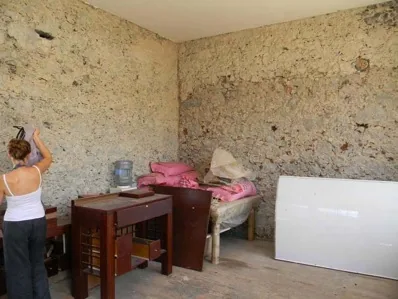
As for the association, we arrived during a “hot” period, when the work (funded by Lamento Rumeno) on the new headquarters was being completed.
We hoped to help with the move, but it happened late (Cape Verdean timings are different from ours… luckily the workers were paid by project and not by the hour…), by which time we were already on the other islands. Silvia told us how the work was carried out, on a budget, and we discovered that even local people whose animals have been saved, lend or have lent their help free of charge.
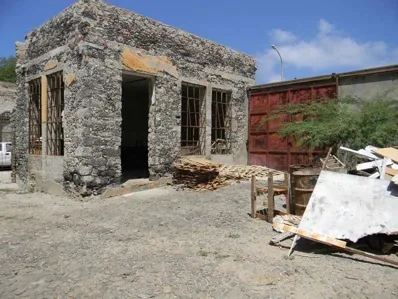
In charge of the old headquarters is Dona Nanda, tireless and multi-talented. During the period we were in Mindelo there were no vets (we left on 4 October for Santo Antao and Pietro was due to arrive on the 5th).
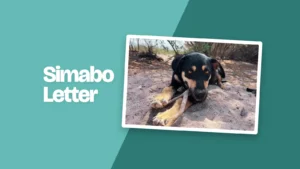
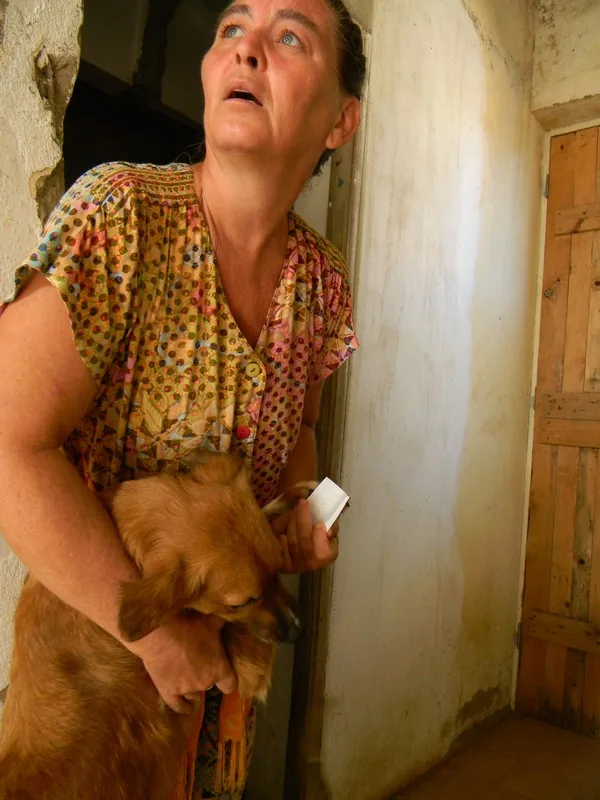
Within two hours, the time I spent at the old headquarters photographing the guest dogs, I witnessed several appointments but above all two injured dogs arrived: one with an eye hanging out, which I didn’t photograph, and another with a hind leg skinned and the flesh exposed and the other completely open. Nanda didn’t panic, treated and stitched up that poor animal that I thought wouldn’t make it, and instead I later found out it recovered well!
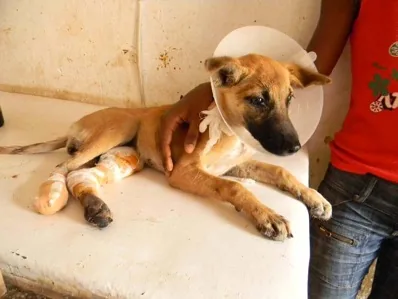
I was very struck by the difference in equipment compared with our veterinary surgeries with aseptic consulting rooms… you definitely need to be good to go and help Simabo… so many things are seen in a continuous cycle… There is certainly so much need… and the eyes of those animals thank you from the heart.
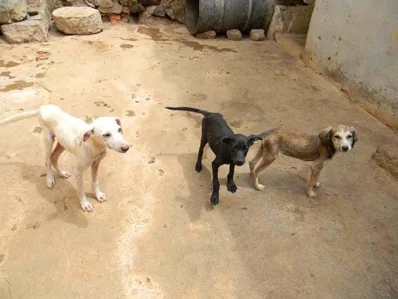
In Sao Vicente, besides Mindelo we visited Sao Pedro with Silvia, where there was talk of a “collection” operation on the strays that amounts to certain death, usually with strychnine… and it seemed that Mindelo might be involved in the operation too… but luckily it turned out that the reports were unfounded…
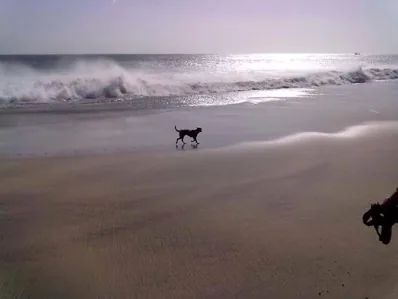
The association carries out sterilisation and gives antiparasitic treatments here in Sao Pedro too (a fishing village with beautiful beaches and lovely waves for surfing), and in Salamansa, another small village on the island.
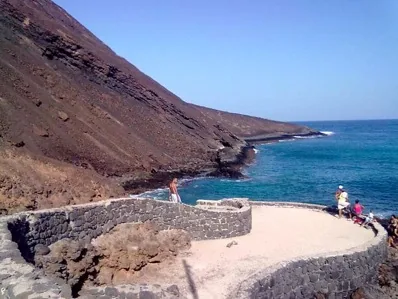
Our tour took us to Baia das Gatas (which does not mean “cats” but “sharks”, but luckily there is a breakwater so swimming is perfectly safe) and Calhau where on Sundays at the Chez Loutcha restaurant you can enjoy a buffet for 15 euros per person with music and dancing entertainment (and even a vegan can get fed!). And after the hearty lunch, here we are at the natural pool at the foot of the volcano.
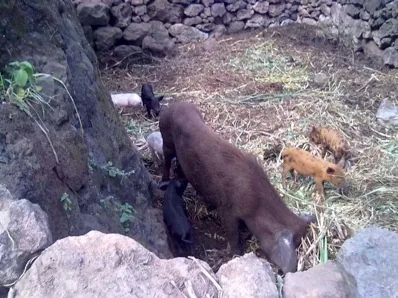
After Sao Vicente we moved on to Santo Antao (guesthouse in Ponta do Sol). One-hour trip by ferry… a constellation of little fishing villages… this is known as the greenest island in CV and there are vast fields, or rather terraces (you need to be agile to get to them), cultivated. Here too, unfortunately, there is no shortage of farms.
One thing that struck me, besides the black sand, is that before they start building houses, they make the bricks…
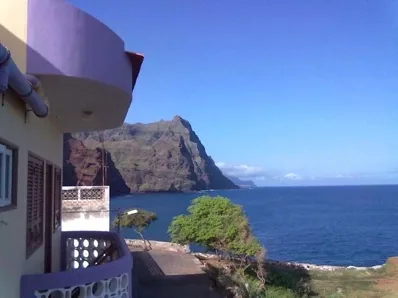
Life here is very modest but runs in harmony between people and animals (here, as in the villages of Sao Vicente, the dogs seem better off than in Mindelo, and in the streets you see men, dogs and chickens, goats).
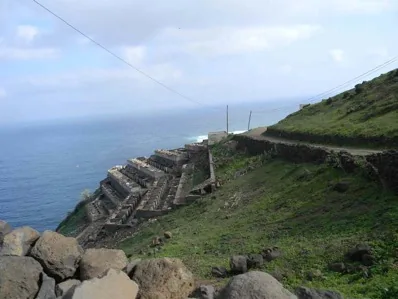
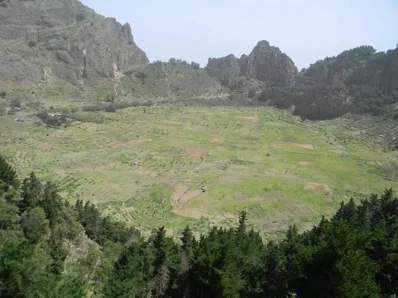
We recommend Cova de Paul (the volcano crater now used for grazing and agriculture) and Fontainhas, but there are also plenty of trails and trekking routes. In the villages we find the characteristic thatched-roof houses of Santo Antao.
The ferry back to Mindelo (from where we had our flight to Sal that same evening) left late and shortly afterwards we learned from Silvia that our flight had been cancelled (luckily we had relied on CV Info Service, which dealt with the airline and got us a hotel night paid for while waiting for the next flight (they wanted to put us on the earlier one, shame we were on the ferry…).
At this point we go to Silvia’s to say goodbye to all the creatures living with her, including the 2 kittens we entrusted to her, and we meet the volunteer vet Pietro.
We leave for Sal on 9 October. Soon we realise how different the landscape is… Santa Maria is a very touristy place and frequented by Europeans (even the prices here are more or less like at home). Here there are a huge number of super-luxury hotels and residences, with very well-kept gardens when water is scarce in Cape Verde… the contradictions of mass tourism.
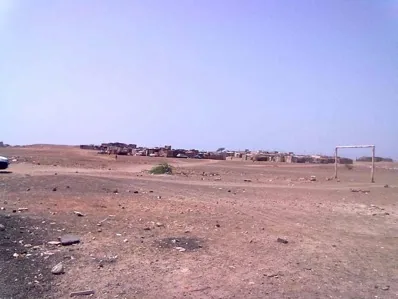
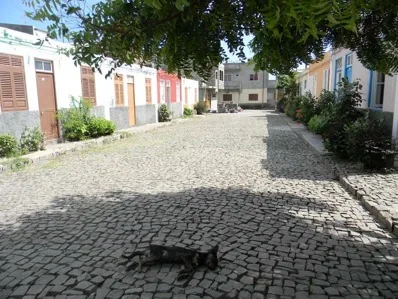
When we decide to do the tourist tour of the island, though, we realise it’s not all like that: Espargos (the capital of Sal, with 8,000 inhabitants) and Palmeira reveal the typical features seen on the previous islands: a much simpler atmosphere, houses very poorly kept on the outside, bedraggled dogs…
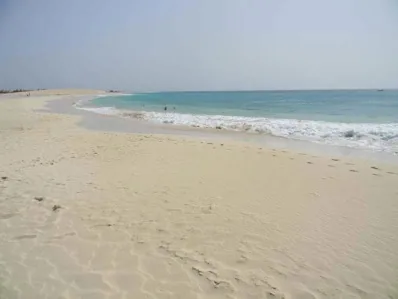
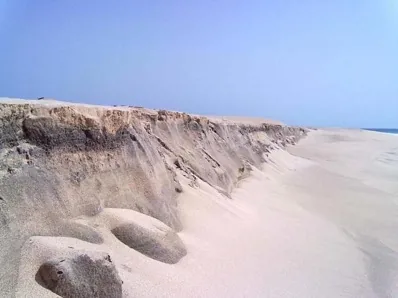
Of course, Sal also has some beautiful landscapes… kilometres of golden beaches with very few visitors (although unfortunately on all the islands fish caught here is cleaned on the beach), the salt pans of Pedra Lume (the salt pans are worth trying for a swim! You really do stay afloat!), Buracona with its Odjo d’Agua, a hole in the rock beneath which the Atlantic bubbles, reflecting a beautiful blue, the lovely Ponta Preta beach…
Also, there’s really no chance to be bored, they’ve invented loads of tourist attractions: swimming with sharks (a few metres away), the trip to see dolphins, the boat trip to fish (!), the Neptune (a lovely little boat with a glass hull from which you can see a wreck from the 1800s and the statue of Christ – apparently it’s there to bless fishermen), with the possibility of a lovely swim in the open sea with the guides).
But the main reason that pushed me to visit Sal were the turtles… In fact it is the third most important place where adult turtles go to lay their eggs (the first destinations in Cape Verde are Boavista and Maio, but Sal is central in terms of transport from one island to another).
Silvia had told us about SOS Tartarugas (www.sostartarugas.org), which also launched a petition against the killing of strays in Sal. The founder is Jacquie Cozens, who also makes documentaries for the BBC. For 4 years, the years of the association’s history, she has lived in Santa Maria with her partner.
It seems that the period when the turtle is most in danger is between June and September, when it comes out of the water to lay its eggs on the beach… In this season the volunteers patrol the beaches at night to drive away any poachers. Turtle meat trade is illegal in CV too, but hunting is still practised.
In October we were told that the season when females lay their eggs was over, so their job was to check the nests.
They gave us the chance to take part in a morning excursion and I must thank M. Sousa Martins, a Portuguese man who speaks a bit of Italian and really put himself out to make us understand what the volunteer work involves and answered an awful lot of questions.
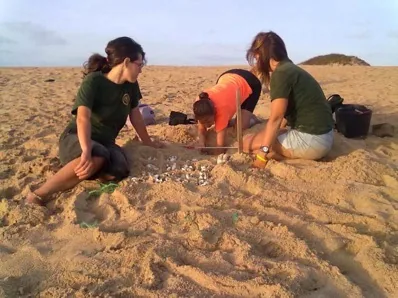
We dug up the nests together with her and another volunteer (which can contain from 80 to 100-120 eggs and the simpler ones are found at a depth of about 50 cm), trying to understand the percentage of eggs that hatch in each nest and the reason why the eggs that remained were still closed, discovering that it is the crabs that suck the nourishment from the foetus.
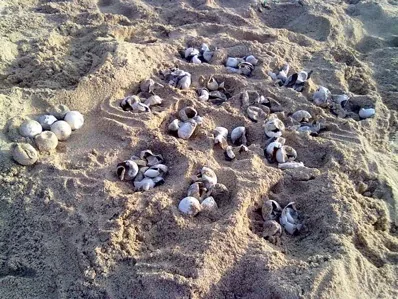
Once the little turtle is born there are many problems that put its survival at risk: pollution (the beach, which is known full well to be a nesting site, was also the most polluted), fish and sharks (apparently they remember the place where they see the babies go into the water, so the volunteers often change the place where they release them), the city lights, which make them head in the opposite direction to the sea (apparently red lights do not bother them, but unfortunately there were also lots of white lights in the town).
The little ones apparently have a survival rate of 1 in a thousand!!!!!
Some information on the Caretta Caretta turtle, the species present in Cape Verde: http://www.elicriso.it/it/animali_regno/caretta_caretta/. It has absolutely nothing to do with what shops sell as a water turtle, which has legs turned into flippers and can retract neither flippers nor head.
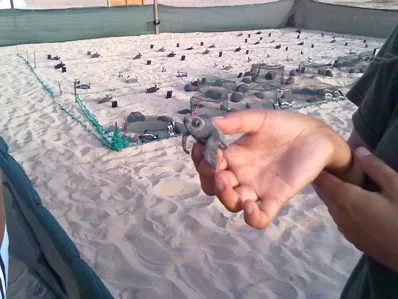
Sos Tartarugas has obtained a fenced-off stretch of beach in front of a huge hotel, in the Ponta Preta area, called INCUBADORA where they take the nests at risk (because perhaps they are too close to the sea or near rocks).
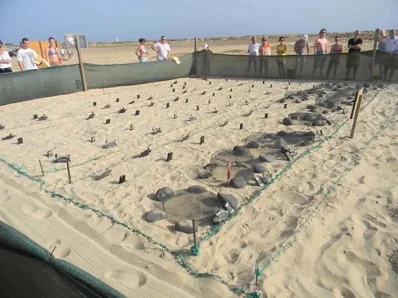
Here every afternoon the volunteers meet the tourists, giving them the chance to adopt a little turtle for 10 euros, and dig up the nests that, according to their calculations, should already have hatched and give information.
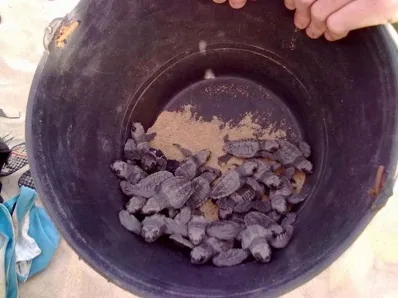
We went twice and the second time we were lucky because about twenty little turtles were born during the night and they showed them to us, and then they would release them in the evening.
At night there is always a volunteer present; those who do not do the night shift can start the day at 6 with the first excursion and finish at 18, but with a smile on their face..
Most of the volunteers are biologists, but computer scientists and teachers have also taken part (even PE teachers..). In short, anyone can take part, but it is preferable to speak at least English.
Unfortunately on 16 October we were already back in Italy in the cold, but with the intention of returning soon to lend a hand…
Laura and Cristian